
Table of Contents
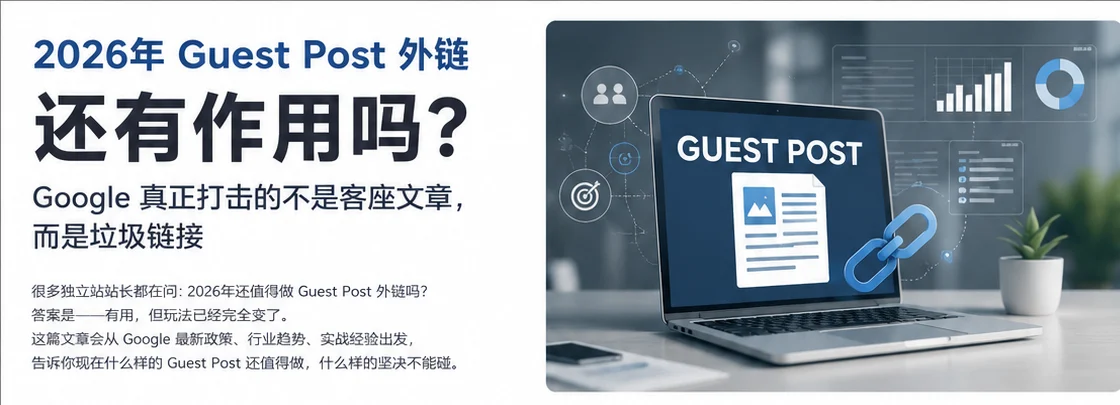
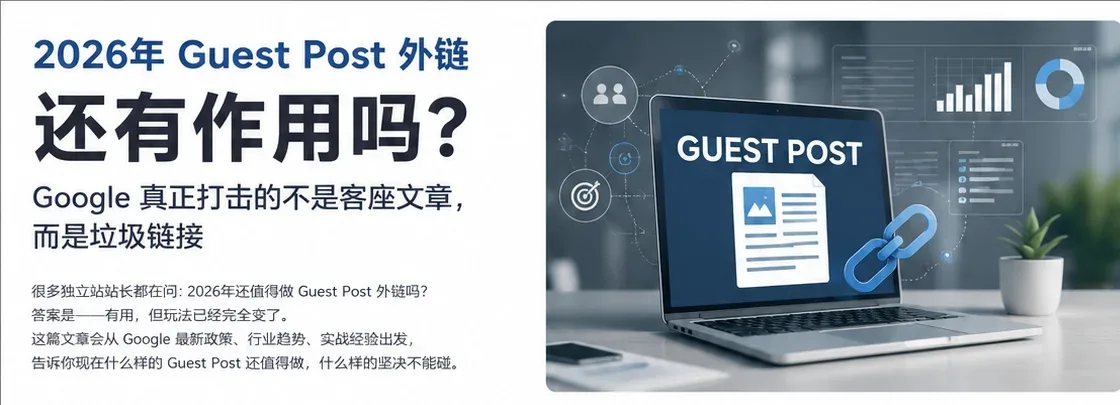
If you work in Google SEO in 2026, you have probably asked a practical question: do guest post backlinks still work? Yes. Quality guest posts can still be valuable backlink sources, provided you move beyond buying placements in bulk, stuffing keyword anchors and judging sites only by DR.
Effective guest posting is closer to an editorial content partnership. The article appears on a website relevant to your business, with real readers and organic traffic. It answers readers’ questions, and the link fits naturally into the context. If an article exists only to pass ranking signals, it may be an expensive spam link, however impressive its DR looks.
Key takeaway: guest post backlinks are still worth considering in 2026, but priorities should shift from DR, DA and volume to niche relevance, real traffic, and content and editorial quality.
1. Why Guest Post Backlinks Still Matter in 2026
The main value of a guest post is to place your brand, content and website in an established industry context, rather than simply add a link on another domain. The more relevant that context is to your business, the more meaningful the link becomes.
1. Niche Relevance Makes a Link a More Credible Recommendation
For a SaaS website, a guest post link from a software, growth, startup or technology publication usually makes more sense to readers than a link from an unrelated general site with high DR. Readers can understand why the publication mentions you, and search engines can better understand the relationship between the two pages.
That is why niche relevance comes first in my 2026 guest post screening process. Strong metrics can help with screening, but cannot replace relevance. Ahrefs also advises against relying on DR alone: overall site quality, user experience and real organic traffic matter too.
2. Quality Guest Posts Build Brand Awareness and Referral Traffic
A guest post read by your target audience should offer more than another referring domain in an SEO tool. It can generate brand awareness, branded searches, direct visits, leads and future partnerships. Even with a nofollow or sponsored link, that business value can remain if the publication and audience are a good match.
3. Good Links Belong in Useful Content, Not Pages Built for Links
Guest posts worth publishing in 2026 have one thing in common: the article should be worth reading even without its link. It needs a clear topic, useful information, original insights or experience, rather than 800 words assembled just to hold an anchor text.
2. What Is Google Targeting in 2026?
People sometimes interpret “Google is targeting guest posts” as “Google bans guest articles.” That is inaccurate. Two separate policies matter here: link spam and site reputation.
1. Link Spam: Paid Links Should Not Be Presented as Natural Endorsements
Google’s current link spam policy identifies practices such as buying or selling links for rankings, paid articles with links that pass ranking credit, and guest articles with over-optimized anchor text. It also recognizes advertising and sponsorship as normal business practices, provided links are marked appropriately.
For clearly paid placements, Google recommends rel="sponsored"; rel="nofollow" is also acceptable. I support quality guest posts for content distribution, brand awareness and referral traffic, but buying paid dofollow links that pass PageRank should not be presented as a Google-approved white-hat strategy.
2. Site Reputation Policy: Using an Established Site’s Reputation to Rank
Google updated its Site Reputation Policy on August 28, 2026, stating that enforcement would differ between the European Economic Area (EEA) and other regions from August 30. The core concern remains third-party content published mainly to gain higher rankings by using an established host site’s ranking signals.
This does not mean all third-party articles violate the policy. Google’s current policy lists columns, opinion pieces, editorial articles and third-party content genuinely intended for readers, rather than search manipulation, as content that is not automatically a violation.
Google also pays attention to the host site’s actual involvement: whether page design fits the main site, content quality is consistent, author and editorial responsibilities are clear, and the content is widely copied to other sites. This reinforces a distinction for guest posting in 2026: genuine editorial collaboration and mass-produced content exploiting a host’s reputation are very different products.
3. Three Core Standards for Choosing Guest Post Sites
Standard 1: The Industry and Page Must Be Relevant
Start with the topics a site covers over time, then assess whether your planned article fits naturally. A relevant category in the main navigation is not enough: review dozens of recent posts to see whether coverage consistently focuses on that industry. A site that writes about everything may offer less niche value than its high DR suggests.
Standard 2: Real Organic Traffic from Relevant Sources
A worthwhile guest post site should have ongoing organic traffic, not just an impressive third-party authority metric. Check whether long-term traffic is stable, ranking keywords match the site’s topic, and traffic is concentrated on a few unusual pages. Real traffic is no guarantee, but it helps filter out sites with attractive metrics and few actual readers.
Standard 3: Genuine Content and Editorial Standards
Recent articles should show genuine authorship, editing, categories, internal links, citations and a sensible update process. They should not all look mass-produced from one template. A site that openly accepts every industry, keyword and anchor text as long as you pay is rarely a strong quality signal.
Use DR and DA as screening aids. DR in particular is a third-party measure of backlink strength, not an official Google website authority score. In 2026, I would prefer a relevant, actively managed site with real readers and moderate metrics over an obviously unrelated site chosen for a single number.
4. Choosing Dofollow, Nofollow or Sponsored Links
For a natural editorial recommendation with no payment or exchange, an ordinary link does not need a special rel attribute.
For advertising, sponsorship or a clearly paid placement, Google recommends sponsored; nofollow is also acceptable. Do not overlook brand awareness and referral traffic because you believe only dofollow links matter, and do not describe paid dofollow links as risk-free.
In practice, a healthy backlink profile will not contain only one link attribute. Natural brand growth produces a mix of dofollow, nofollow and sponsored links, branded anchors, plain URLs and natural phrases. Aim for a credible overall profile rather than forcing exact-match anchors into every link.
5. My Guest Post Workflow for 2026
Screen for industry relevance first, then review metrics.
Confirm stable organic search traffic and review the last 6–12 months.
Manually review recent articles for content quality, author details, editorial input and outbound link density.
Choose a guest post topic that genuinely fits the publication’s audience, rather than writing only to place a link.
Favor brand names, URLs and natural phrases for anchor text, and be cautious about frequent exact-match anchors.
For paid promotion, use sponsored or nofollow attributes as required by Google’s guidelines.
Treat guest posts as one part of a broader backlink strategy, not your only way to improve rankings.
6. Guest Posting Still Has Value; Outdated Tactics Have Less
If your approach is to buy a spreadsheet of thousands of sites, sort them by DR, insert one exact-match keyword per article and ignore relevance or readership, that model offers less and less value in 2026.
If your article appears on a genuinely active niche site, with editorial review, readers, organic traffic and useful content, and the link is a natural part of that context, guest posting remains a practical tool for SEO, brand awareness and content distribution.
The real question is whether you are getting a recommendation with useful context, an audience and a basis for trust, or merely a link that appears in an SEO report.
FAQ: Common Questions About Guest Post Backlinks
1. Do guest post backlinks still work in 2026?
Yes, but results depend heavily on relevance, real traffic, content quality and how the link is acquired. Quality guest posts on niche sites still have value. Mass-produced, low-quality posts created only for rankings are more likely to be ignored or create risk.
2. Does a guest post need a dofollow link to be useful?
No. Dofollow links may pass ranking signals, while nofollow and sponsored links can still bring brand awareness, referral traffic and real visitors. Google recommends sponsored for paid placements and also accepts nofollow.
3. Can buying guest posts lead to a Google penalty?
Paid content partnerships are not inherently the problem. The risk comes from buying links that pass ranking credit to manipulate rankings. Google’s Link Spam Policy requires appropriate rel attributes for advertising and sponsored links.
4. Is niche relevance more important than a high DR?
For most long-term SEO projects, I prioritize niche relevance. DR helps assess backlink strength, but it is not a Google metric and cannot, by itself, prove that a site has real readers, traffic or sound editorial standards.
5. How can I quickly assess a guest post site?
Check three things first: strong topic relevance to your industry, stable organic traffic from reasonable sources, and recent articles that show genuine editorial standards. If all three look good, use DR, referring domains and traffic trends for further screening.
6. How do guest posts relate to niche backlinks?
Guest posting is a way to earn exposure and backlinks. Niche backlinks emphasize a close match between the linking site, your industry, the page topic and your target audience. Ideally, a guest post is a high-quality article on a genuinely relevant website.
Need Guest Posts on Truly Relevant Websites?
KennyDTC does not recommend buying backlinks blindly for a DR score.
If you are building guest post links for a business website, SaaS product, B2B company, affiliate site or brand, we can screen sites for niche relevance, real organic traffic, content quality and editorial standards, then plan guest posts and backlinks around your goals.
Focus your budget on links worth keeping. Get a KennyDTC Guest Post Plan and prioritize websites that are relevant, active and valuable.