
Table of Contents
KENNY’S FIELD TEST | GUEST POSTS
An Older SEOquake Version + Screenshots and Indexing Results from 15 Real Platforms
Key Takeaway
My Assessment SEOquake cannot guarantee that Google will index a guest post. It can help you rule out clearly poor platforms before paying.
After building more than 10,000 backlinks, I have become less willing to rely on DA and DR alone.
These metrics have value, but many sites with attractive numbers still leave articles unindexed after a week, two weeks or longer. The client has paid and the article is written, yet Google cannot find the page. Such a backlink has limited value.
What matters more to me now is this: does a guest post on this platform have a good chance of being indexed quickly?
This article uses no complex tools or paid Semrush or Ahrefs subscriptions. A free Chrome extension and 15 real publishing cases provide a low-cost first check.
What This Article Covers
- Explain why I use the English version of SEOquake 3.13.5.
- Share L, LD, Rank, LD/L and actual indexing results for 15 platforms.
- Provide a practical, free screening framework.
- Provide a download link for the English 3.13.5 CRX at the end.
Spend Where It Matters Start with what you can check for free. Run an initial test, then invest more as the data changes.
1. The Free Tool: SEOquake 3.13.5
This test uses the English version of SEOquake 3.13.5, a free browser extension from Semrush. It displays backlinks, Semrush Rank and other metrics below Google search results.
Once installed, it should show a row of SERP metrics beneath each result when you search for a domain. However, I have seen many reports that versions 4.0.0, 4.1.0 and 4.1.1 no longer show the results bar. Some users also lost the sidebar.
As of September 2026, the Chrome Web Store lists version 4.1.1, and the official description still includes SERP Overlay and free Semrush metrics. Not everyone has problems after updating; browser version, region or changes to Google’s pages may also affect behavior.
Issues Reported by Users
- The SERP results bar disappears from Google search results.
- The SEOquake sidebar or top toolbar does not appear.
- SEO metrics no longer appear beneath results.
- The updated interface differs significantly from the familiar workflow.
My Approach The newer version may work for you. For this test, I need a version that consistently displays SERP data.
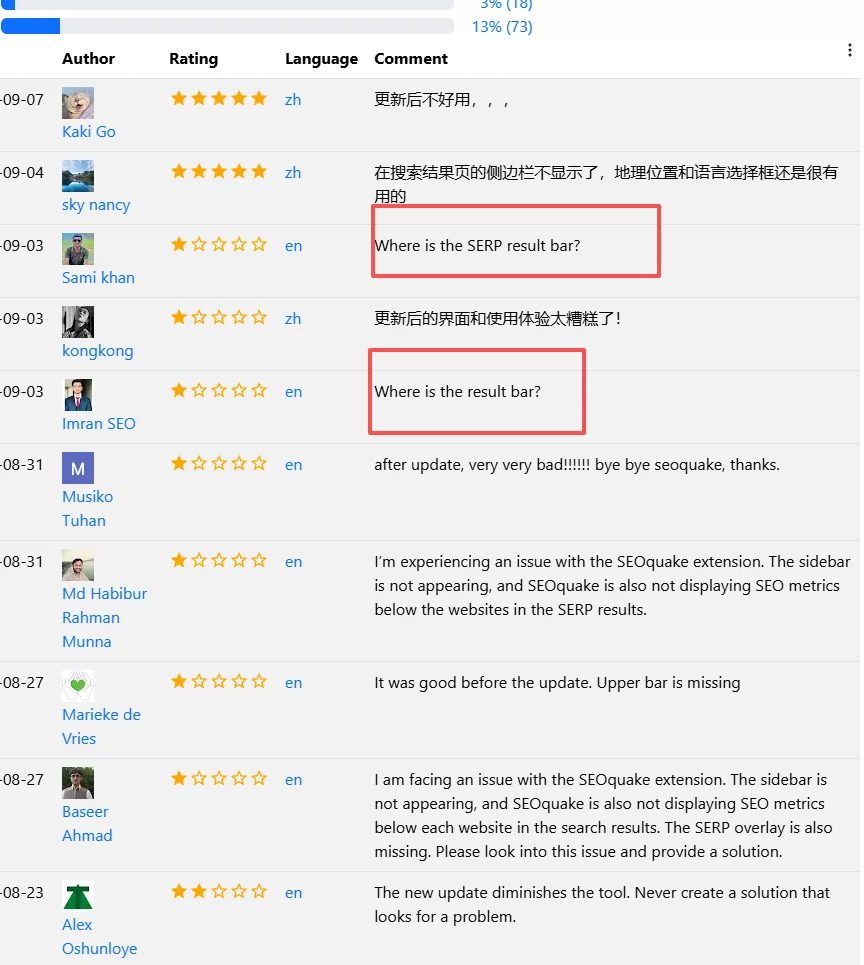
Figure 2. Some users report missing SERP bars, sidebars or metrics after updating SEOquake
For me, the tool needs to do its job and display data reliably. I would rather work than spend each day troubleshooting missing buttons just to stay on the newest version.
That is why I used the English version of SEOquake 3.13.5 for this test.
Official page: SEOquake Chrome Web Store
2. The Three Metrics I Check
When you search Google for a website’s homepage, SEOquake displays these three metrics. Always compare homepages consistently; do not mix homepage and article-page data.
|
Metric |
Meaning |
How to Interpret It |
|---|---|---|
|
L |
SEMrush Backlinks |
Backlinks to the page shown in the search result. This article consistently uses the homepage. |
|
LD |
SEMrush Subdomain Backlinks |
Backlinks to the entire subdomain. This helps assess whether links are concentrated on the homepage. |
|
Rank |
Semrush Rank |
Lower values generally indicate stronger visibility. N/A means Semrush has not identified enough organic search visibility. |
An Additional Structural Metric
Formula R = LD ÷ L
This ratio is not an official SEOquake score. It is an observational metric I derived from these 15 publishing cases.
If L and LD are nearly equal, the subdomain has few backlinks beyond those pointing to its homepage. If LD is much larger than L, links are more widely distributed, suggesting more external discovery paths to internal pages.
A Simple, Low-Cost Workflow
- Search Google for the full domain name.
- Confirm that the result is the homepage.
- Record L, LD and Rank from the SEOquake results bar.
- Calculate LD ÷ L.
- Use the risk ranges below to prioritize a site, run a small test or skip it.
3. Full Data from 15 Real Platforms
All 15 platforms have actual publishing results: five indexed in 1–3 days, five took over 7 days, and five were not indexed. We start with group ranges, then examine each platform and its original screenshots.
Ranges Across the Three Groups
|
Actual Outcome |
Sample |
L Range |
LD Range |
Rank Range |
LD/L Range |
|---|---|---|---|---|---|
|
Indexed in 1–3 days |
5 |
983-34.7K |
53.3K-32.4M |
2.72K-18.5M |
23.6–933.7× |
|
Over 7 days |
5 |
19-20.5K |
72-205K |
16.6M-25.9M/N/A |
1.15–10× |
|
Not indexed |
5 |
111-203K |
278-203K |
25.1M-27.8M/N/A |
1–9.17× |
What the Results Show L and Rank overlap substantially across groups. Only LD/L fully separates the groups in this sample.
L provides a clear counterexample: the unindexed group reaches 203K, while the fast-indexing group starts at just 983. A higher L does not necessarily mean a better publishing opportunity.
Rank is more useful at the extremes. Sites below 500K performed well, but fast and slow indexing both occurred around 16.6M–18.5M.
LD/L provides the clearest separation in this sample: all fast-indexing sites were above 23.6, while sites taking over seven days or not indexed were at 10 or below.
Platform-by-Platform Results
|
# |
Platform |
L |
LD |
Rank |
LD/L |
Result |
|---|---|---|---|---|---|---|
|
1 |
trans4mind.com |
12.8K |
302K |
406K |
23.60 |
Indexed in 1–3 days |
|
2 |
bignewsnetwork.com |
4.77K |
2.23M |
18.8K |
467.50 |
Indexed in 1–3 days |
|
3 |
strefainzyniera.pl |
983 |
53.3K |
18.5M |
54.20 |
Indexed in 1–3 days |
|
4 |
siit.co |
11.8K |
630K |
365K |
53.40 |
Indexed in 1–3 days |
|
5 |
vocal.media |
34.7K |
32.4M |
2.72K |
933.70 |
Indexed in 1–3 days |
|
6 |
ifashionjaney.com |
239 |
366 |
25.9M |
1.53 |
Over 7 days |
|
7 |
kizifashion.com |
19 |
72 |
N/A |
3.79 |
Over 7 days |
|
8 |
fashionsfusionista.com |
20.5K |
205K |
16.6M |
10.00 |
Over 7 days |
|
9 |
fashionsfave.com |
238 |
273 |
25.4M |
1.15 |
Over 7 days |
|
10 |
fashionlexa.com |
561 |
791 |
N/A |
1.41 |
Over 7 days |
|
11 |
kanefashion.com |
277 |
320 |
N/A |
1.16 |
Not indexed |
|
12 |
myheadbands.com |
201K |
201K |
N/A |
1.00 |
Not indexed |
|
13 |
fashionwebarticle.com |
276 |
2.53K |
25.1M |
9.17 |
Not indexed |
|
14 |
crystalamulets.com |
203K |
203K |
N/A |
1.00 |
Not indexed |
|
15 |
cecifashion.com |
111 |
278 |
27.8M |
2.50 |
Not indexed |
Notes: K = thousand; M = million. A lower Rank is stronger. N/A means no Rank data is available. All L values refer to homepage search results.
4. Group One: Five Sites Indexed in 1–3 Days
How to Read This Group Start with the fast-indexing group. It includes sites with strong Rank and one with a Rank of 18.5M. Their shared feature is an LD/L ratio above 23.6.
Case 01 trans4mind.com | Strong Fast-Indexing Example

Figure 3. trans4mind.com SEOquake SERP screenshot | Actual result: indexed in 1–3 days
|
L |
LD |
Rank |
LD/L |
Actual Outcome |
|---|---|---|---|---|
|
12.8K |
302K |
406K |
23.60× |
Indexed in 1–3 days |
- A Rank of 406K is relatively strong. The domain’s search visibility is a clear positive signal.
- LD/L is about 23.6, the lowest value in the fast-indexing group and its provisional lower boundary.
- This screenshot shows homepage data. L of 12.8K represents homepage backlinks, not backlinks to a newly published guest post.
Case 02 bignewsnetwork.com | High-Confidence Fast Indexing
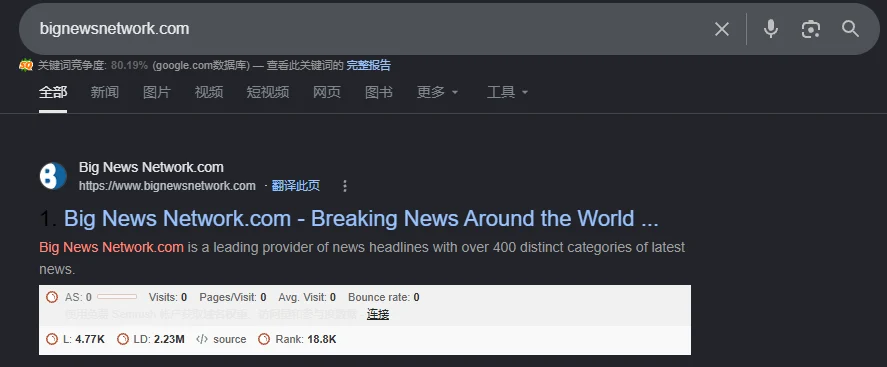
Figure 4. bignewsnetwork.com SEOquake SERP screenshot | Actual result: indexed in 1–3 days
|
L |
LD |
Rank |
LD/L |
Actual Outcome |
|---|---|---|---|---|
|
4.77K |
2.23M |
18.8K |
467.50× |
Indexed in 1–3 days |
- L is not the highest in this group, but LD reaches 2.23M, showing a large backlink profile across the subdomain.
- A Rank of 18.8K is very strong. Crawl activity and search visibility are clear positive signals.
- LD/L is about 467.5. Backlinks are not concentrated only on the homepage, making this a fast-indexing example with a healthy distribution.
Case 03 strefainzyniera.pl | Fast Indexing Despite Weak Rank
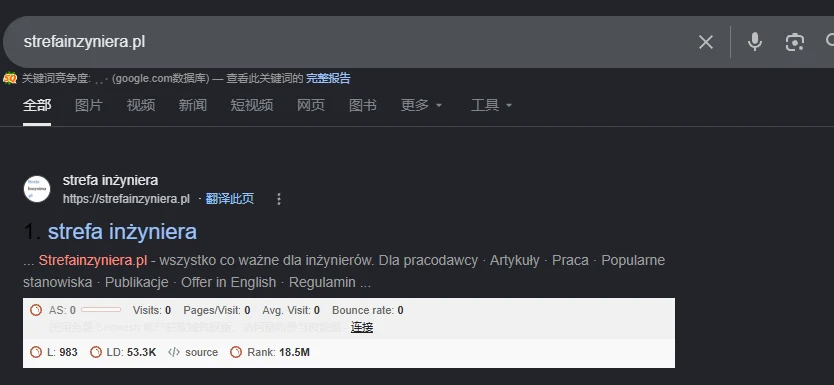
Figure 5. strefainzyniera.pl SEOquake SERP screenshot | Actual result: indexed in 1–3 days
|
L |
LD |
Rank |
LD/L |
Actual Outcome |
|---|---|---|---|---|
|
983 |
53.3K |
18.5M |
54.20× |
Indexed in 1–3 days |
- A Rank of 18.5M looks weak, yet the post was indexed in 1–3 days. Rank alone should not be a strict rejection rule.
- L is only 983, but LD is 53.3K, giving an LD/L ratio of about 54.2.
- This is a key counterexample: a low page-level L does not necessarily mean slow indexing.
Case 04 siit.co | Typical Fast-Indexing Metrics

Figure 6. siit.co SEOquake SERP screenshot | Actual result: indexed in 1–3 days
|
L |
LD |
Rank |
LD/L |
Actual Outcome |
|---|---|---|---|---|
|
11.8K |
630K |
365K |
53.40× |
Indexed in 1–3 days |
- L, LD and Rank show no obvious weakness. This is a typical profile for a fast-indexing platform.
- Rank is 365K, below 500K, and LD/L is about 53.4. Both core signals are positive.
- Together with trans4mind.com, this supports screening for a relatively strong Rank and a ratio above 20.
Case 05 vocal.media | The Strongest Site in This Group

Figure 7. vocal.media SEOquake SERP screenshot | Actual result: indexed in 1–3 days
|
L |
LD |
Rank |
LD/L |
Actual Outcome |
|---|---|---|---|---|
|
34.7K |
32.4M |
2.72K |
933.70× |
Indexed in 1–3 days |
- With a Rank of 2.72K and LD of 32.4M, this is among the strongest sites in the sample.
- LD/L is about 933.7, far above the current fast-indexing boundary.
- This type of platform is worth testing first, but fast indexing does not guarantee rankings or real traffic from the backlink.
Fast-Indexing Group: Conclusion All five sites indexed in 1–3 days had LD/L ratios above 23.6. A Rank below 500K adds confidence. Even with a Rank of 18.5M, fast indexing remains possible when the ratio is high enough.
5. Group Two: Five Sites Taking Over 7 Days
How to Read This Group The slow-indexing group does not consist only of sites with small numbers. One has an L of 20.5K, showing how relying on L alone can waste your budget.
Case 06 ifashionjaney.com | Clear Slow-Indexing Risk

Figure 8. ifashionjaney.com SEOquake SERP screenshot | Actual result: over 7 days
|
L |
LD |
Rank |
LD/L |
Actual Outcome |
|---|---|---|---|---|
|
239 |
366 |
25.9M |
1.53× |
Over 7 days |
- L and LD are both low, while Rank exceeds 20M. All three signals are weak.
- LD/L is only 1.53, suggesting that subdomain backlinks barely extend beyond the homepage.
- If fast indexing is the goal, I generally would not prioritize spending on this type of platform.
Case 07 kizifashion.com | Very High Slow-Indexing Risk
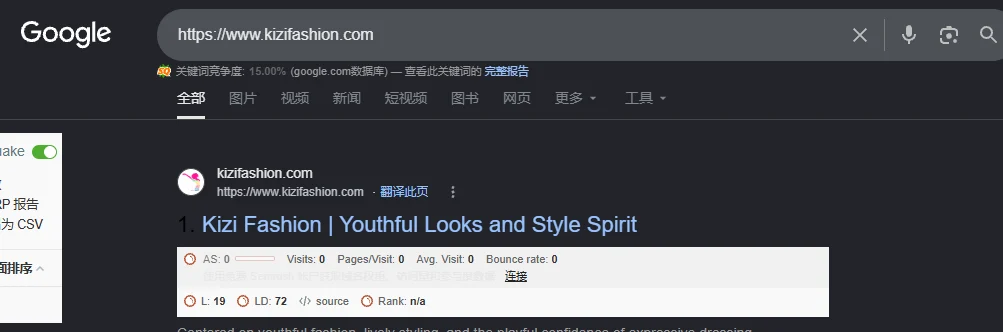
Figure 9. kizifashion.com SEOquake SERP screenshot | Actual result: over 7 days
|
L |
LD |
Rank |
LD/L |
Actual Outcome |
|---|---|---|---|---|
|
19 |
72 |
N/A |
3.79× |
Over 7 days |
- With L of only 19 and LD of 72, the subdomain has very weak overall link discovery signals.
- Rank is N/A: Semrush has not identified enough organic search visibility.
- Low absolute values, a low ratio and no Rank data together indicate a high risk of slow indexing.
Case 08 fashionsfusionista.com | A False Positive from High L
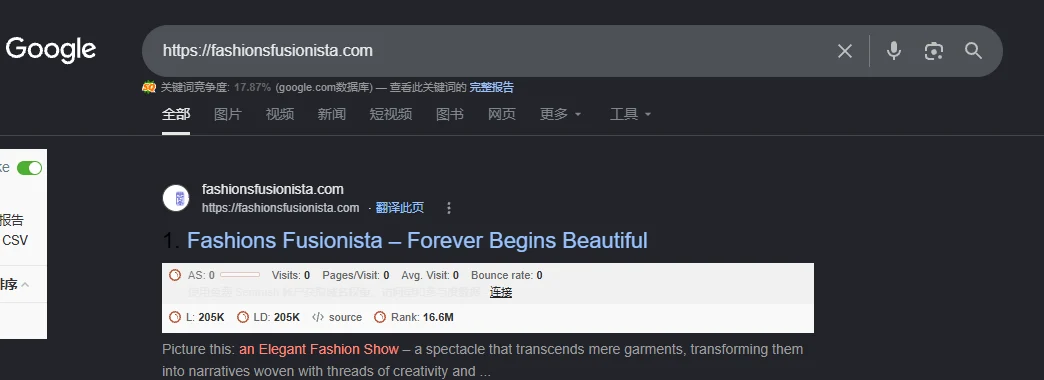
Figure 10. fashionsfusionista.com SEOquake SERP screenshot | Actual result: over 7 days
|
L |
LD |
Rank |
LD/L |
Actual Outcome |
|---|---|---|---|---|
|
20.5K |
205K |
16.6M |
10× |
Over 7 days |
- L reaches 20.5K, making the site look stronger than some fast-indexing sites, yet indexing still took over seven days.
- Its Rank of 16.6M is even better than that of fast-indexing strefainzyniera.pl. Mid-range Rank values can also be misleading.
- The key difference is an LD/L ratio of only 10, right at the current high-risk boundary.
Case 09 fashionsfave.com | A recurring pattern of slow indexing
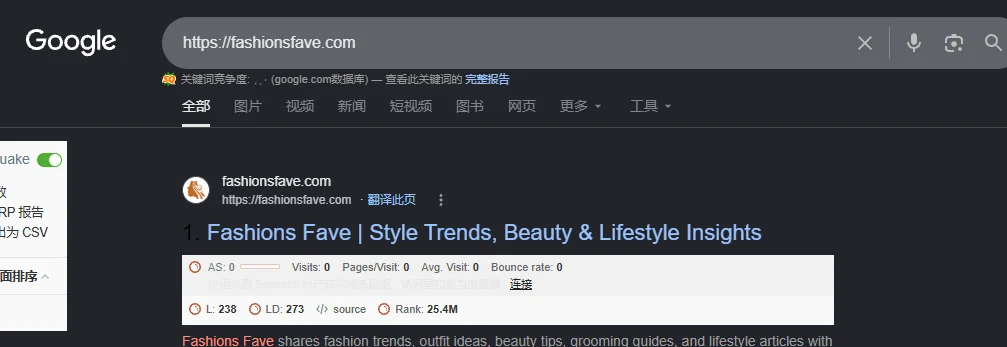
Figure 11. SEOquake SERP screenshot for fashionsfave.com | Actual result: more than 7 days
|
L |
LD |
Rank |
LD/L |
Actual Outcome |
|---|---|---|---|---|
|
238 |
273 |
25.4M |
1.15× |
Over 7 days |
- Its L, LD and Rank are very close to those of ifashionjaney.com, and the actual indexing result is the same.
- Its LD/L ratio is only 1.15×, so almost all backlinks in these metrics are concentrated on the homepage.
- Similar metrics producing similar results make this warning sign for slow indexing more convincing.
Case 10 fashionlexa.com | Indexing remains slow even when L exceeds 300
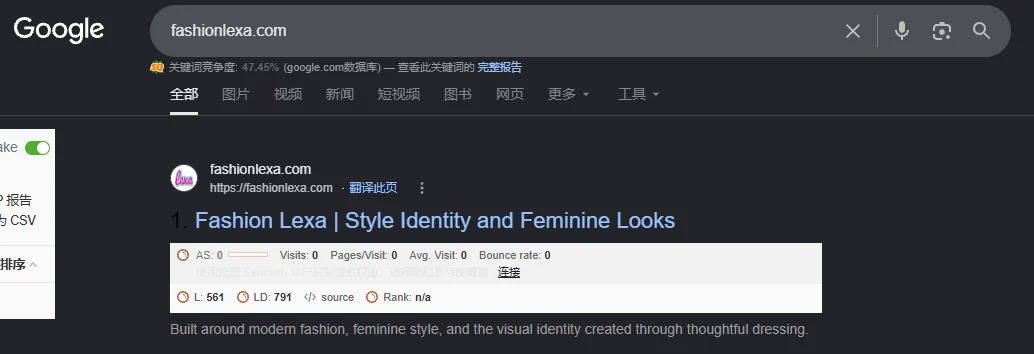
Figure 12. SEOquake SERP screenshot for fashionlexa.com | Actual result: more than 7 days
|
L |
LD |
Rank |
LD/L |
Actual Outcome |
|---|---|---|---|---|
|
561 |
791 |
N/A |
1.41× |
Over 7 days |
- This case shows that the slow-indexing risk zone cannot be defined simply as L below 300. Even with L at 561, indexing was slow.
- LD is still below 1K, Rank is unavailable, and the LD/L ratio is only 1.41×.
- It is more useful to assess the combination of metrics than to set an isolated pass mark for L.
What the slow-indexing group shows All five cases that took more than 7 days had an LD/L ratio of 10× or less. L ranged from just 19 to 20.5K, so relying on L alone will produce false positives.
6. Group Three: Five Sites Not Indexed
How to Read This Group The non-indexed group included two platforms with L above 200,000. Despite these large figures, Rank was N/A and the LD/L ratio was just 1×—clear examples of misleadingly high L.
Case 11 kanefashion.com | High risk of non-indexing
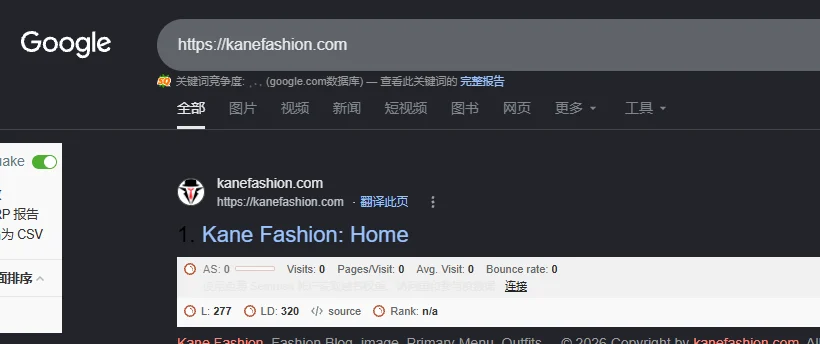
Figure 13. SEOquake SERP screenshot for kanefashion.com | Actual result: not indexed
|
L |
LD |
Rank |
LD/L |
Actual Outcome |
|---|---|---|---|---|
|
277 |
320 |
N/A |
1.16× |
Not indexed |
- L of 277, LD of 320 and Rank of N/A place it squarely in the high-risk zone identified earlier.
- Its LD/L ratio is only 1.16×, suggesting that backlinks to the subdomain have not spread substantially across internal pages.
- Its metrics closely overlap with some cases that took more than 7 days. These three metrics are therefore better for assessing risk than for predicting the exact indexing date.
Case 12 myheadbands.com | The clearest example of misleadingly high L
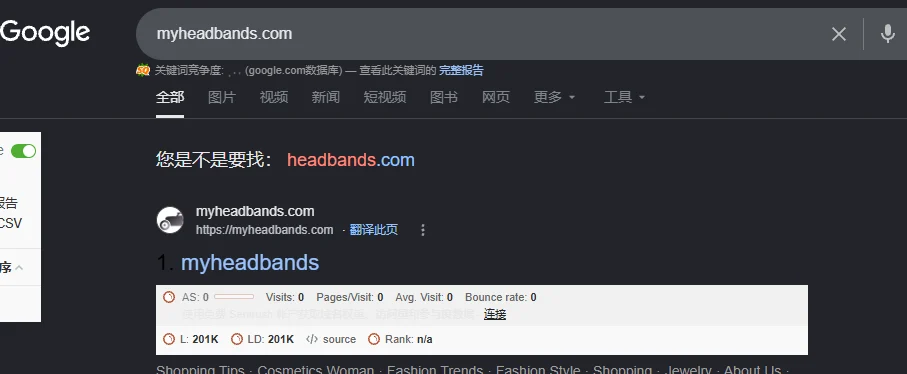
Figure 14. SEOquake SERP screenshot for myheadbands.com | Actual result: not indexed
|
L |
LD |
Rank |
LD/L |
Actual Outcome |
|---|---|---|---|---|
|
201K |
201K |
N/A |
1× |
Not indexed |
- L reached 201K, yet the article was not indexed. This directly shows why the absolute L value cannot be used on its own.
- L and LD are identical, giving an LD/L ratio of 1×. This indicates highly concentrated backlinks or an unusual data pattern.
- More than 200,000 backlinks but no Semrush Rank is a clear mismatch: backlink quantity has not translated into search visibility.
Case 13 fashionwebarticle.com | Still not indexed with a ratio close to 10×

Figure 15. SEOquake SERP screenshot for fashionwebarticle.com | Actual result: not indexed
|
L |
LD |
Rank |
LD/L |
Actual Outcome |
|---|---|---|---|---|
|
276 |
2.53K |
25.1M |
9.17× |
Not indexed |
- Although LD exceeds 1K, L is only 276 and Rank is 25.1M. The overall signals remain weak.
- Its LD/L ratio is about 9.17×, below the lowest ratio in the fast-indexing group.
- This shows that LD above 1K does not automatically deserve a high score. The ratio and Rank still matter.
Case 14 crystalamulets.com | Another example of misleadingly high L
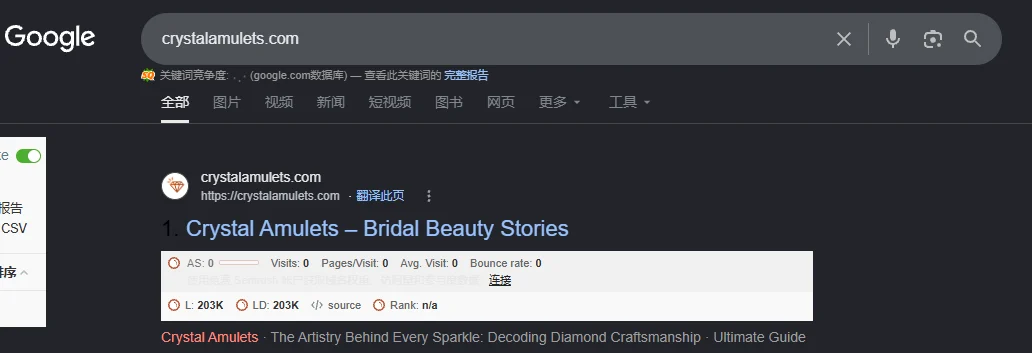
Figure 16. SEOquake SERP screenshot for crystalamulets.com | Actual result: not indexed
|
L |
LD |
Rank |
LD/L |
Actual Outcome |
|---|---|---|---|---|
|
203K |
203K |
N/A |
1× |
Not indexed |
- It closely matches myheadbands.com: both L and LD exceed 200,000, while Rank is N/A.
- Its LD/L ratio is also 1×, and the actual result is also non-indexing.
- This recurring pattern is enough to justify an automatic downgrade in the plugin rather than continuing to award points for high L.
Case 15 cecifashion.com | A rejected case with low backlink metrics and weak Rank
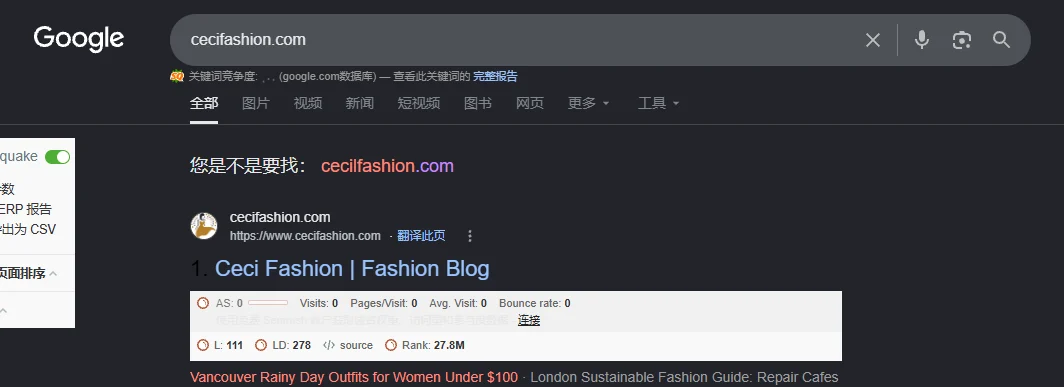
Figure 17. SEOquake SERP screenshot for cecifashion.com | Actual result: not indexed
|
L |
LD |
Rank |
LD/L |
Actual Outcome |
|---|---|---|---|---|
|
111 |
278 |
27.8M |
2.50× |
Not indexed |
- With L at 111, LD at 278 and Rank at 27.8M, none of the three metrics provides strong support.
- Its LD/L ratio is only 2.50×, keeping it firmly in the high-risk zone.
- If the aim is to publish a guest post that Google can discover quickly, I would skip this type of site.
What the non-indexed group shows All five non-indexed cases had an LD/L ratio below 10×. Two repeated the same pattern: L and LD both exceeded 200,000, but Rank was N/A. High L does not necessarily mean meaningful search visibility.
7. Main Conclusions
In one sentence Indexing is not simply about higher L. It also depends on whether backlinks reach internal pages and whether those links correspond to real search visibility.
Conclusion 1: Never Use L Alone
myheadbands.com had L of 201K but was not indexed; strefainzyniera.pl had L of only 983 but was indexed within 1–3 days. Buying placements by L alone would lead to the opposite assessment of these two sites.
Conclusion 2: Rank Is More Useful at the Extremes
Rank below 500K is a clear positive signal in this sample. Rank above 20M or N/A raises risk. The middle range is inconclusive: a site at 18.5M indexed quickly, while one at 16.6M took more than 7 days.
Conclusion 3: LD ÷ L Best Separates These Samples
All five cases indexed within 1–3 days had LD/L ratios above 23.6×. All ten slow or non-indexed cases had ratios of 10× or less. There are not enough cases in the 10–20× range, so it remains a grey area.
Practical Screening Criteria
|
Metric combination |
Provisional grade |
My next step |
|---|---|---|
|
LD/L ≥ 20×; Rank < 500K |
Grade A |
Prioritize for testing |
|
LD/L ≥ 20×; Rank 500K–20M |
Grade B |
Test a small batch |
|
LD/L 10–20× |
Grade C |
Grey area: start with a few placements |
|
LD/L ≤ 10× |
Grade D |
High risk of taking more than 7 days or not being indexed |
|
Rank N/A and LD/L ≤ 1.2× |
Grade E |
Recommend rejecting |
|
Rank > 20M; L < 300; LD/L < 10× |
Grade E |
Recommend rejecting |
Scoring Should Go Beyond Simple Addition
A simple rule that gives more points for a higher L could rate an unindexed site with 200K backlinks as a quality resource. A better approach is to assess backlink distribution first, then Rank, and give L only a small supporting weight.
- Use LD/L as the core measure of backlink distribution.
- Use Rank to check search visibility.
- Treat L as a supporting metric; do not keep adding points simply because its absolute value is high.
- Apply mandatory downgrades for high L with Rank N/A, nearly equal L and LD, or very weak Rank combined with a low ratio.
8. What This Method Can and Cannot Do
This method is a quick screening step before publishing. A guest post may cost tens or hundreds of dollars. Spending a few seconds checking before payment is worthwhile if it rules out clearly high-risk platforms.
Its limits should also be clear:
- It cannot guarantee that Google will index a page.
- It cannot predict the exact day of indexing.
- It cannot tell you whether an indexed article will gain rankings or real traffic.
- It does not replace checks of content quality, internal links from site sections, canonical tags, noindex directives and page status.
- Many negative examples in this sample are fashion sites. Shared networks or similar templates may introduce bias. Further testing should include more industries and independent platforms.
What I Would Do Use SEOquake to screen out clearly unsuitable platforms for free, then test in small batches. Price can be negotiated, but quality should not be sacrificed.
9. Free Download: SEOquake 3.13.5 English CRX
If SERP data disappeared below Google results after you updated to SEOquake 4.0.0, 4.1.0 or 4.1.1, you can try the English SEOquake 3.13.5 CRX used in this test.
Free download SEOquake 3.13.5 CRX File
This is an older English installation package, not a cracked version. It does not unlock any paid Semrush features.
An older version is still an older version, and I would not present it as a permanent solution. Before distributing the package, confirm that you have the right to do so and verify its source and integrity. Use a separate browser profile if possible. If a newer official release works reliably again, return to the officially maintained version.
The file is free. If a free tool can answer the question, there is no need to rush into paying. Install it, run an initial check of L, LD and Rank, then decide whether the guest post platform is worth using.
Kenny Yang
Decide whether it is worth doing before deciding how much to spend.