

Table of Contents
GSC Data from Five Websites
KennyDTC · September 2026

Guest post vendors usually quote traffic figures from Semrush. When buyers see 10K, 30K or 100K, they often start discussing price without asking how close those estimates are to the website’s actual data.
KennyDTC compared five websites with different traffic levels using Google Search Console, Semrush and Similarweb data for August 2026, all on a global basis. The sites are anonymized as A to E. This article answers one question: which tool should you check first when assessing a backlink site’s real organic traffic?
01 Key Findings for Screening Backlink Sites
The short answer: If you simply want to estimate a backlink site’s organic traffic, I recommend starting with Similarweb; use Semrush to examine keywords, landing pages, countries and niche relevance. If the owner provides complete GSC data, use that as the final reference. (Though very few owners are willing to share it.)
In this sample, Similarweb was closer to GSC on four of five sites. Its mean absolute error was 35.10%, compared with 55.55% for Semrush; median errors were 43.59% and 67.42%. Similarweb was not accurate every time, but its estimates were less far off overall.
|
Metric |
Similarweb |
Semrush |
|---|---|---|
|
Sites Closer to GSC |
4 |
1 |
|
Mean Absolute Error |
35.10% |
55.55% |
|
Median Absolute Error |
43.59% |
67.42% |
|
Overestimates and Underestimates |
2 overestimates, 3 underestimates |
1 overestimate, 4 underestimates |
This is a practical warning for buyers: Semrush Organic Traffic should not be quoted as a site’s actual monthly traffic. Website A had 2,231 GSC clicks, but Semrush estimated just 174. Website E had 476 GSC clicks, compared with a Semrush estimate of 130. Such gaps can make a healthy small site look almost traffic-free.
My workflow is simple: use Similarweb to cross-check traffic scale, Semrush to examine the SEO structure, and GSC to confirm actual results whenever available.
02 Evidence from Five Niche Websites
Test Methodology
All five sites were assessed using global Google web search data for August 2026. Total GSC clicks were the benchmark. For Semrush, we used organic traffic from Domain Analytics. For Similarweb, we estimated organic traffic as monthly unique visitors × organic search share.
Error rate = |tool estimate − GSC clicks| ÷ GSC clicks × 100%. The GSC screenshots for websites B and C show rounded figures in tens of thousands, so those results are approximate.
The metrics are not identical: GSC counts clicks, Similarweb Monthly Unique Visitors counts individuals, and Semrush estimates visits. Multiplying unique visitors by organic search share reduces the effect of repeat visits and provides a more conservative estimate for screening backlink sites. This is the method used in this test, not an official Similarweb metric.
Traffic Comparison at a Glance
|
Website |
Traffic Level |
GSC Clicks |
Similarweb Estimate |
Similarweb Error |
Semrush Traffic and Error |
Closer Estimate |
|---|---|---|---|---|---|---|
|
Website A |
Small |
2,231 |
1,134 |
49.19% below |
174 · 92.20% below |
Similarweb |
|
Website B |
Medium |
36,900 |
39,126 |
6.03% above |
33,500 · 9.21% below |
Similarweb |
|
Website C |
Medium |
14,900 |
21,395 |
43.59% above |
20,300 · 36.24% above |
Semrush |
|
Website D |
Small |
3,990 |
1,843 |
53.81% below |
1,300 · 67.42% below |
Similarweb |
|
Website E |
Micro |
476 |
367 |
22.87% below |
130 · 72.69% below |
Similarweb |
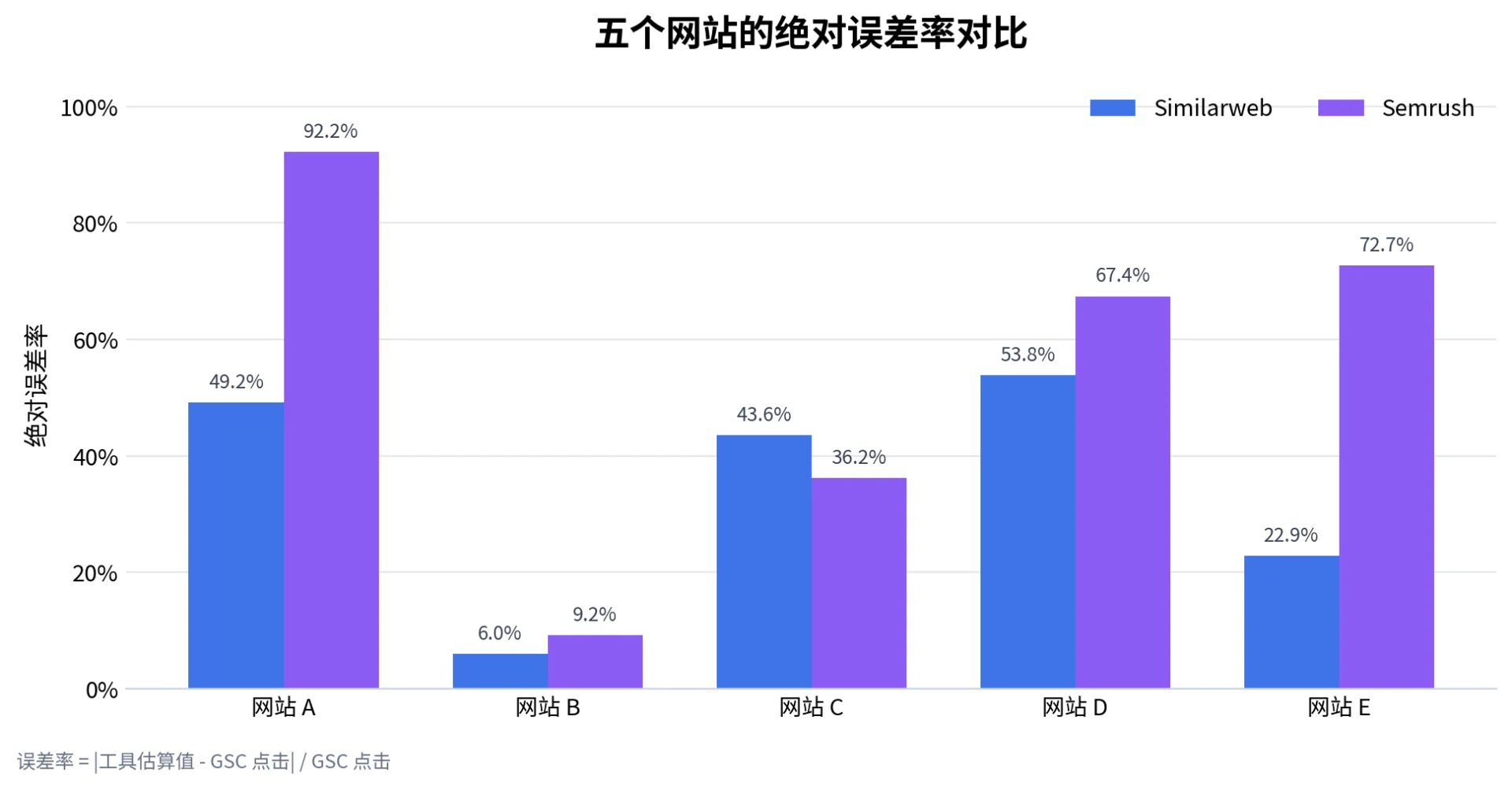
The main takeaway is not that one tool always wins, but that Semrush greatly underestimated traffic for several small sites. Similarweb also underestimated websites A and D, though by a smaller margin.
Website A: Small Site
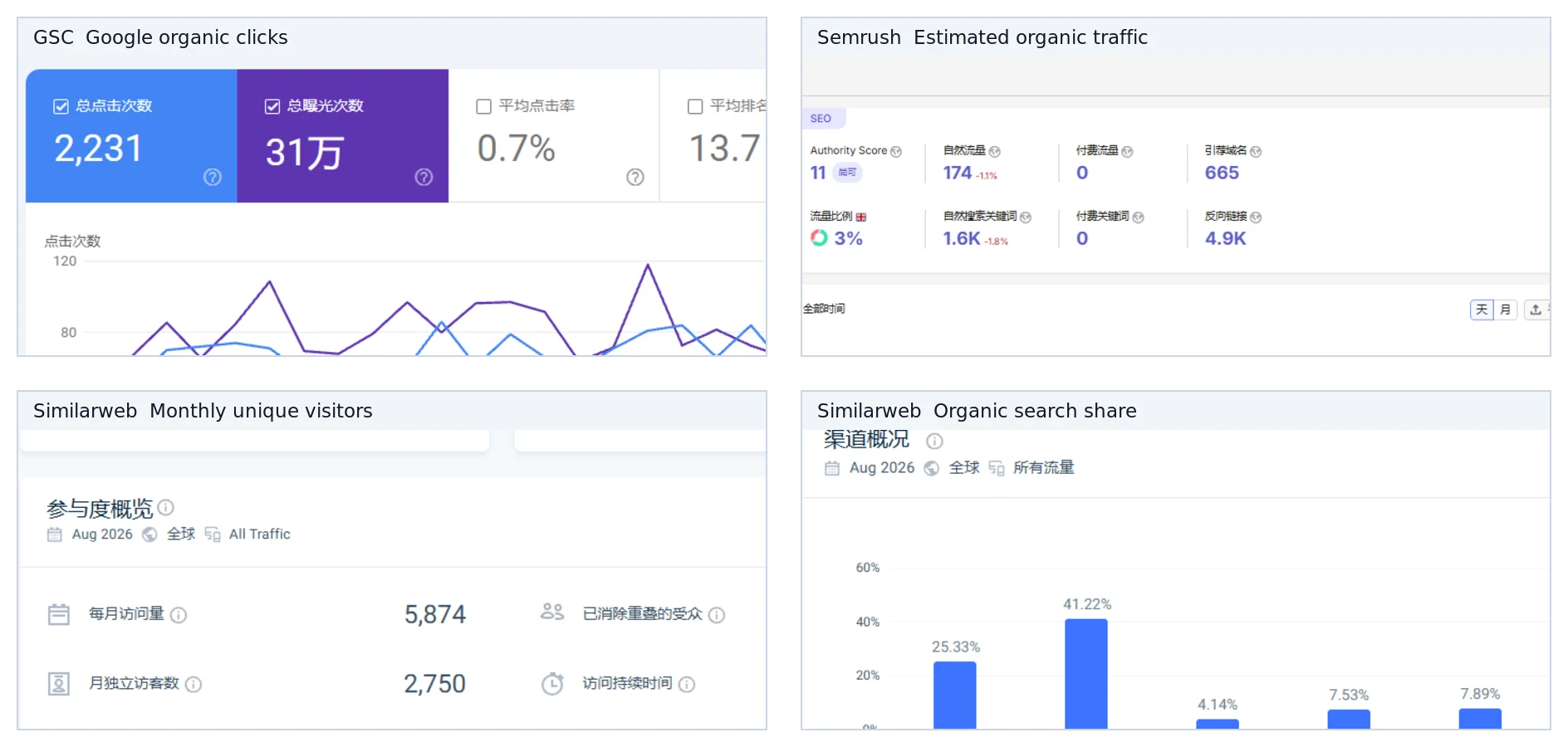
GSC recorded 2,231 clicks. Similarweb’s estimate of 2,750 × 41.22% = 1,134 was 49.19% low; Semrush’s 174 was 92.20% low. Similarweb was closer, but even its estimate was roughly half the actual figure.
Website B: Medium Site
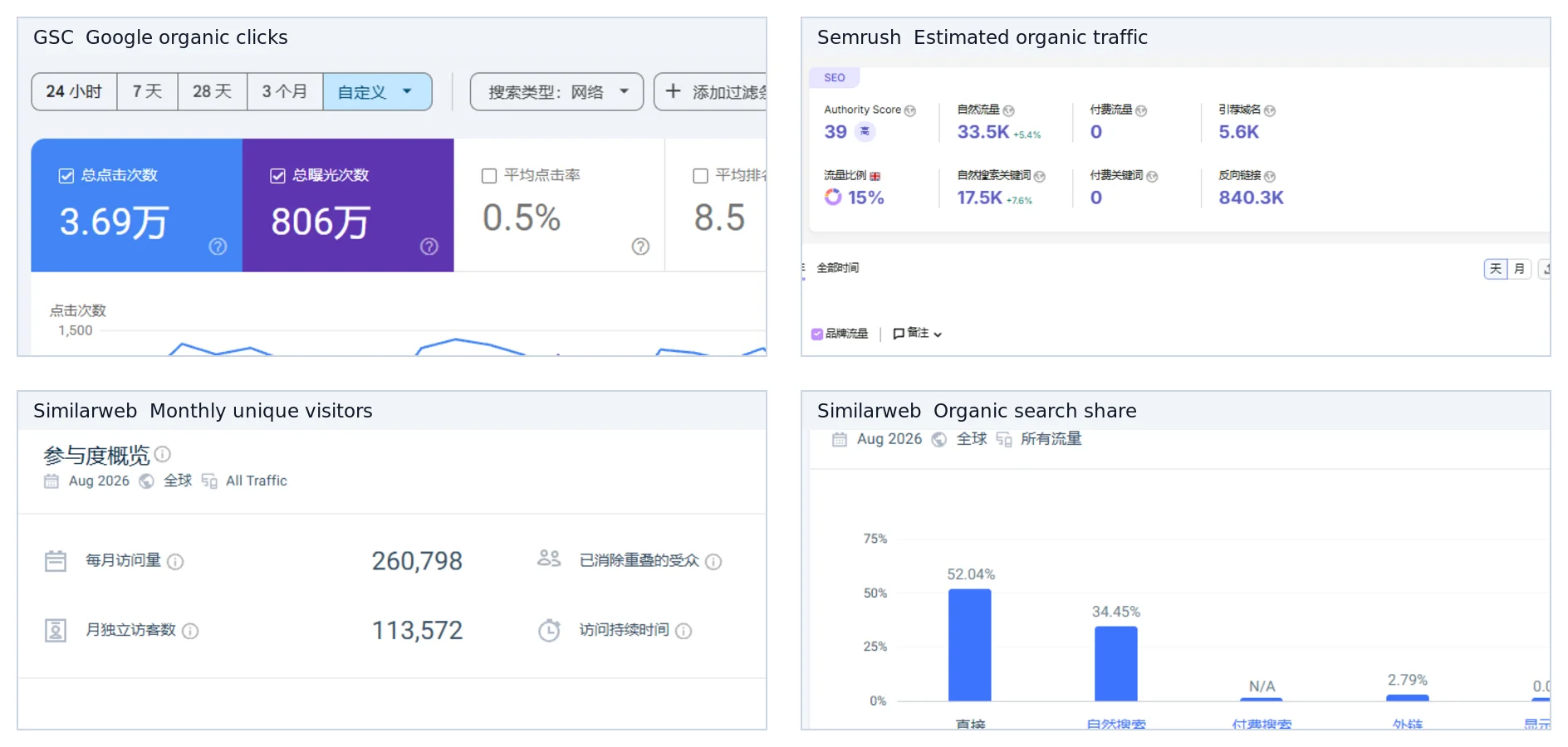
GSC recorded approximately 36,900 clicks. Similarweb’s estimate of 113,572 × 34.45% = 39,126 was about 6.03% high; Semrush’s 33,500 was about 9.21% low. Both were within an acceptable range, with Similarweb slightly closer.
Website C: Medium Site
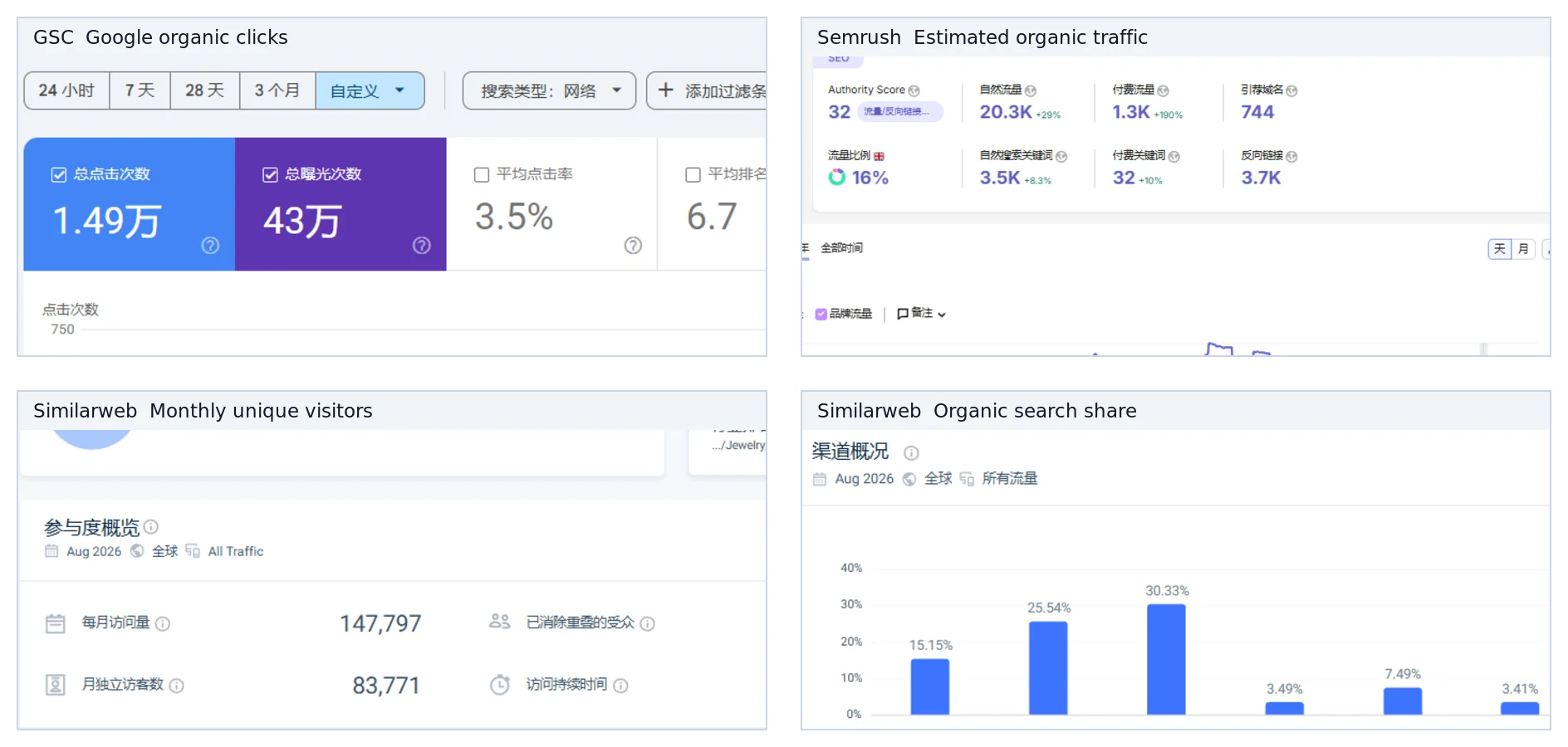
GSC recorded approximately 14,900 clicks. Similarweb estimated 21,395, about 43.59% high; Semrush estimated 20,300, about 36.24% high. This was the only site where Semrush was closer, but neither estimate represents the actual analytics figure.
Website D: Small Site
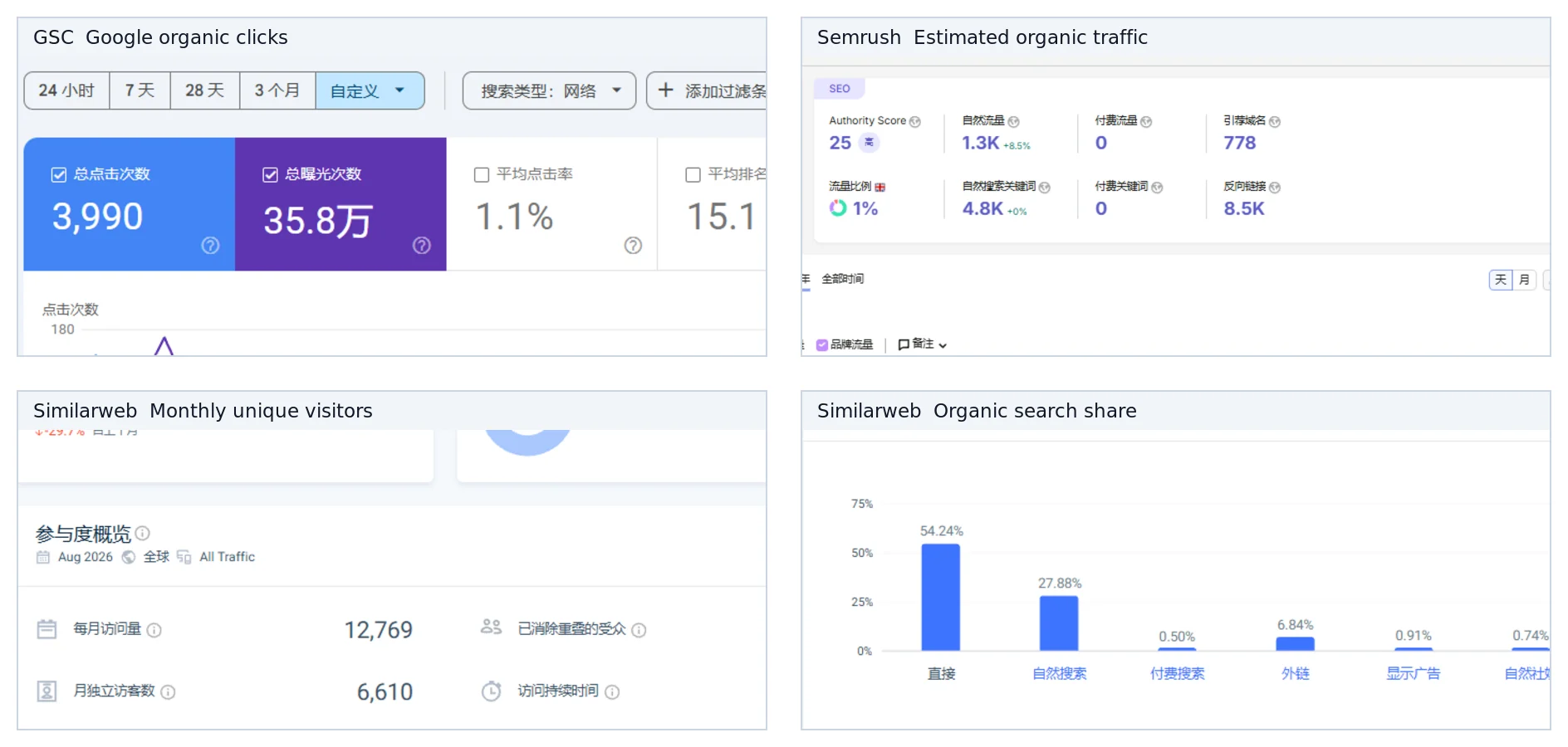
GSC recorded 3,990 clicks. Similarweb estimated 1,843, 53.81% low; Semrush estimated 1,300, 67.42% low. Both substantially underestimated traffic. Similarweb was simply the closer of the two.
Website E: Micro Site
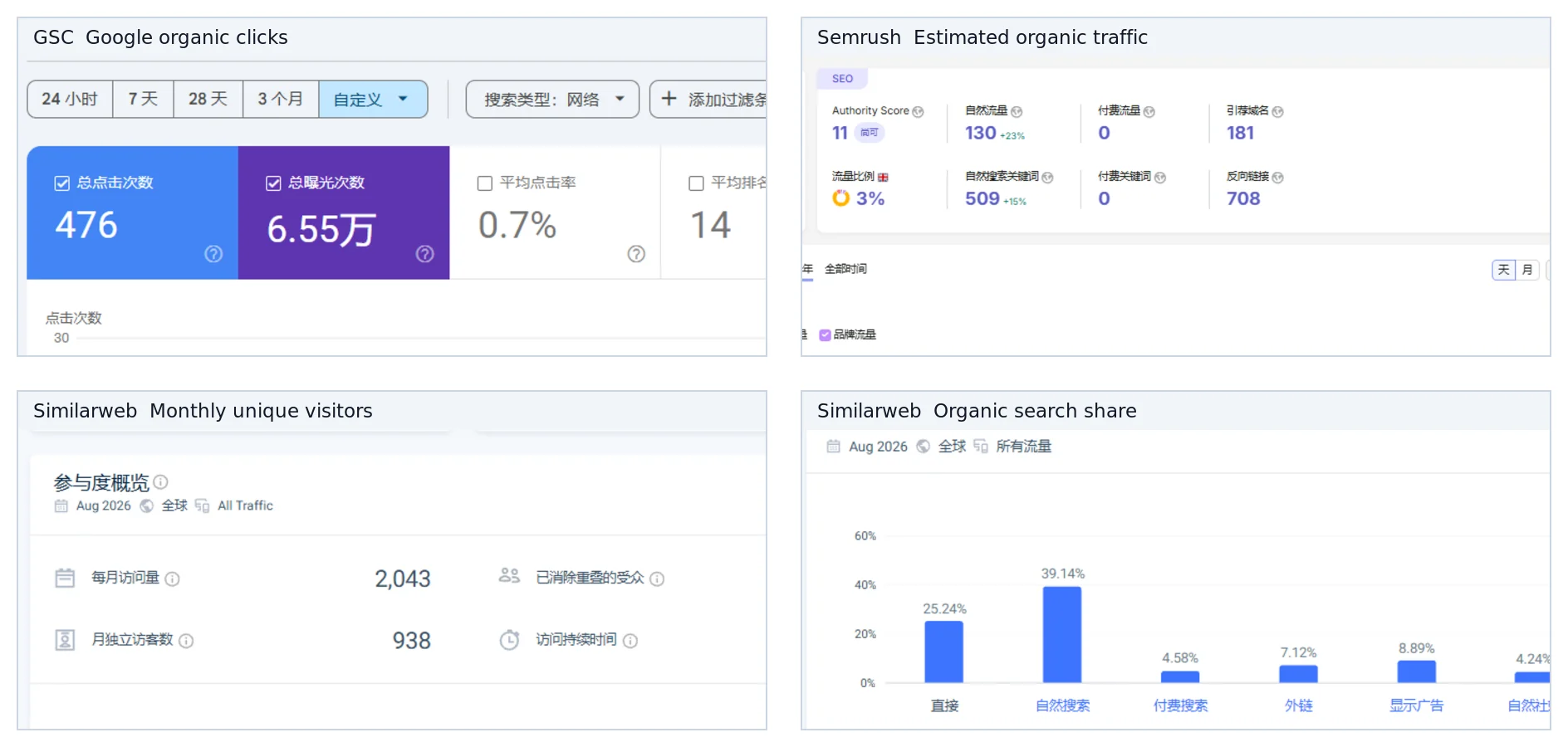
GSC recorded 476 clicks. Similarweb estimated 367, 22.87% low; Semrush estimated 130, 72.69% low. For this micro site, Similarweb gave a much more realistic sense of traffic scale.
Results by Traffic Level
Similarweb was closer on all three micro and small sites. Its mean error was about 41.96%, compared with 77.44% for Semrush. Each tool won one of the two medium sites; their mean errors were similar, at 22.73% for Semrush and 24.81% for Similarweb.
These five samples support one conclusion: Similarweb is a better starting point for estimating a backlink site’s traffic scale, especially when Semrush severely underestimates a small site. Still, check for conflicting estimates on each site, and never treat a third-party figure as the final basis for payment.
03 Common Debates and External Research
Debate 1: The Tools Measure Different Things
Many articles compare Similarweb traffic directly with Semrush Organic Traffic and declare a winner. The problem starts with the metrics. Semrush says Domain Analytics estimates search traffic from keyword rankings, search volume and average click-through rates. Similarweb combines clickstream data, direct measurement, partner data and public data to estimate visits and channel mix. One relies more on ranking models, the other on behavior models, so different results are normal.
For backlink buyers, Semrush is useful for identifying which keywords and pages drive visibility. Similarweb helps assess audience size and channel mix. Calling Semrush’s traffic estimate “actual traffic” is a common mistake.
Debate 2: Is Similarweb Accurate for Small Niche Sites?
Similarweb acknowledges that small sites may show limited data or N/A. Some desktop-only features may not display data below 5,000 monthly visits. Earlier SparkToro research also found weaker Similarweb performance for sites with fewer than 5,000 monthly GA users.
In this test, however, Similarweb was closer to GSC on all three micro and small sites. That does not invalidate earlier research: the samples, dates, metrics and formulas differ. Similarweb also updated its Marketing Channels model in April 2026 and recalculated 37 months of historical data. The August 2026 screenshots in this article use that updated model.
Debate 3: Why Do Studies Reach Different Conclusions?
SparkToro compared third-party tools with Google Analytics across 641 websites and 7,692 site-months. Similarweb most often estimated traffic within 30% of GA user counts. However, Semrush had the higher overall correlation coefficient: 0.790 versus 0.659 for Similarweb.
These findings are compatible. Correlation measures whether sites move together and have similar relative rankings; error rate measures how far an individual estimate is from the actual value. Backlink buyers care more about the latter: whether a quoted 50,000 means 45,000 or 5,000 directly affects price. SparkToro also compared whole-site traffic metrics, not the Semrush Domain Analytics organic traffic used here. Its study offers methodological context, rather than replacing this GSC comparison.
Debate 4: Similarweb Is Still an Estimate
A peer-reviewed PLOS ONE study covered 86 websites across 26 countries and 19 industries. Against Google Analytics, Similarweb underestimated total visits by an average of 19.4% and unique visitors by 38.7%, while website traffic rankings remained highly correlated. This supports using Similarweb for scale, trends and comparisons, rather than treating a precise estimate as actual analytics data.
My final recommendation remains the same: use Similarweb to estimate a backlink site’s traffic scale, use Semrush to assess niche relevance, and use GSC for final verification. If a vendor sends only a Semrush overview screenshot to justify a high-traffic price, investigate further.
04 Backlink Consultation
If you are buying guest posts and have dozens or hundreds of sites to review, but vendors provide only DA, DR, AS and a Semrush screenshot, send me your list.
I will focus on the following checks:
- Whether Semrush and Similarweb estimates differ substantially
- Whether traffic comes from relevant industry keywords or unrelated terms and a single page
- Whether target countries match, trends are stable, and traffic has recently dropped sharply
- Whether article sections have Google visibility and prices reflect actual traffic
Contact KennyDTC · Send an Inquiry, Mention “backlink traffic screening” and include the site list, quoted prices, target countries and client’s industry. I will first remove sites that are clearly poor value, then identify those worth discussing further.
05 References
All links point to official documentation or original research.
1 Google Search Console Performance Report
Google defines clicks as visits initiated by clicking a Google search result. This article therefore uses GSC clicks for the same period as the benchmark for Google organic search performance.
2 Semrush Traffic Analytics vs Domain Analytics
Semrush explains that Domain Analytics estimates search traffic from keyword positions, search volume and average click-through rates. Traffic Analytics uses clickstream data to estimate traffic across all channels. The two sets of figures are not expected to match.
3 Semrush Organic Rankings Positions Report
Semrush describes Organic Traffic as estimated monthly visits based on a domain’s organic rankings and keywords in its database. It helps assess keywords and organic visibility, but does not equal clicks recorded in the site’s own analytics.
4 Similarweb Data Methodology
Similarweb says its estimates combine direct measurement, contributor networks, partners and public data, with models used to calibrate website traffic and audience figures.
5 Similarweb Unique Visitors
Similarweb defines Monthly Unique Visitors as the number of distinct individuals visiting a domain during the analysis period. Repeat visits by the same person count as one unique visitor.
6 Similarweb Marketing Channels
Similarweb defines Organic Search as unpaid clicks from organic search results and allocates channel sources by visits. It updated its channel model and recalculated historical data in April 2026.
7 SparkToro Third Party Traffic Estimate Study
SparkToro compared third-party estimates with Google Analytics across 641 websites and 7,692 site-months. Similarweb was more frequently close to actual values, while Semrush had a higher raw correlation coefficient. Different accuracy measures can therefore produce different conclusions.
8 PLOS ONE Website Analytics Comparison
A 2022 peer-reviewed study compared 86 websites. Against Google Analytics, Similarweb underestimated total visits by an average of 19.4% and unique visitors by 38.7%. However, traffic rankings across sites were still strongly correlated.
KennyDTC